With the nation’s largest commercial vehicle inventory, full of best-selling makes and models, Model 1 is the place to start and end your search for the right vehicle, or an entire fleet.
We’re committed to providing you with all the services you need to manage your fleet — not just at the start, but for the entire lifecycle for every vehicle in your operation.
With access to the nation’s largest commercial vehicle inventory, we can help you find exactly what you need for your fleet. And when the right solution doesn’t exist, we’ll help create it.
Originally published: 2014
Last updated: February 2026
Minibuses continue to serve as one of the most versatile tools in commercial transportation. For many organizations, they strike the right balance between passenger capacity, maneuverability, and long-term operating cost.
If you regularly transport more people than a passenger van can handle — but don’t need the size or CDL requirements of a full-size bus — a commercial minibus often becomes the most practical solution.
In this guide, we’ll break down what defines a minibus, typical capacity, regulatory considerations, and what fleet managers should evaluate before making a purchase decision.
What Is a Minibus?
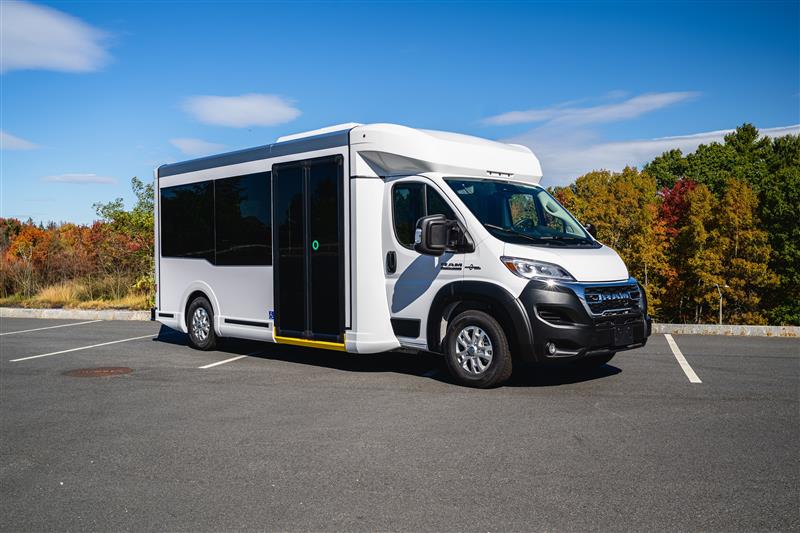
A minibus is a mid-sized commercial passenger vehicle designed to carry more passengers than a traditional van, but fewer than a full-size transit bus.
Most minibuses are built on commercial cutaway chassis platforms and customized for applications like:
Healthcare and patient transport
Senior living communities
Churches and nonprofits
Corporate shuttle programs
Municipal and community transit
Campus transportation
They’re purpose-built for repeat use — not occasional group travel.
How Many Passengers Can a Minibus Carry?
While passenger vans typically cap out around 8-15 passengers, minibuses expand capacity well beyond that range. Most commercial minibuses are configured for 18-28 passengers, with layouts ranging from 12 to 35 depending on accessibility and route needs.
Passenger capacity is influenced by:
ADA wheelchair positions
Lift or ramp configuration
Luggage storage needs
Seat spacing preferences
CDL threshold planning
For many fleets, the goal isn’t simply maximizing seats — it’s right-sizing capacity to match actual ridership and route demands.
Over-spec’ing capacity can increase cost and regulatory complexity. Under-spec’ing leads to inefficiencies and multiple trips. The right balance matters.
Minibuses have a center aisle which helps maintain order during loading and unloading of passengers. Being able to stand upright makes passengers far more comfortable waiting while other passengers get settled. Beyond the center aisle is also the flexibility of how the seats are arranged. Seating capacity can vary significantly based on wheelchair positions and layout configuration. Seats can all be forward facing or can be all placed on the perimeter of the vehicle.
Minibus vs. Passenger Van vs. Full-Size Bus
Choosing between vehicle types comes down to operational fit.
Feature
Passenger Van
Minibus
Full-Size Bus
Capacity
8-15
12-35
30-60+
CDL Required
Often No
Sometimes
Usually Yes
Maneuverability
High
Moderate
Lower
Ideal Use
Small groups
Mid-size routes
High-volume transit
Many organizations move into a minibus when:
Passenger vans are consistently full
Accessibility requirements increase
Growth is projected
A full-size bus would be underutilized
It’s often the “right-sized” solution for growing transportation programs.
Depending on design and configuration, many minibuses offer amenities such as luggage racks, wheelchair lifts, and enhanced interior lighting — features not typically found in standard passenger vans. These extras are often not available on passenger vans. There is no need to look for a large bus for these offerings when they are available in a smaller vehicle.
Regulatory Considerations in 2026
CDL Requirements
In many states, transporting 16 or more passengers (including the driver) requires a Commercial Driver’s License (CDL). Requirements vary by state and vehicle configuration, so fleets should confirm regulations before finalizing specifications.
ADA Compliance
For organizations providing public or contracted transportation, ADA compliance is often required. Learn more about our ADA-compliant transportation options.
This may include:
Wheelchair lifts or ramps
Securement systems
Proper aisle clearance
Compliant signage
These decisions are best made during vehicle specification — not after delivery.
A minibus is a long-term asset. Evaluating total cost of ownership helps ensure the vehicle supports your operation for years to come.
Key factors include:
Acquisition Cost Chassis selection, body configuration, accessibility equipment, and customization level.
Fuel or Energy Efficiency Gas, diesel, and emerging electric options each carry different operating profiles.
Maintenance & Service Support Access to qualified service centers and parts availability directly impact uptime. Reliable service and parts support plays a critical role in minimizing downtime.
Lifecycle Expectations How many years will the vehicle serve your route? What does replacement planning look like?
When properly specified, a minibus can deliver strong lifecycle value while maintaining operational flexibility.
Electric and Alternative Fuel Minibuses
Consolidating passenger transport into a single minibus can reduce total vehicles on the road and simplify route management. As sustainability initiatives expand, electrification continues to grow within the medium-duty passenger vehicle market. Electrification continues to expand in the medium-duty passenger vehicle market. Model 1 offers a growing range of electric and alternative fuel vehicles.
Electric minibuses are increasingly considered for:
Campus routes
Municipal transit
Fixed-route shuttle services
Sustainability-driven programs
Fleet managers evaluating electric options should consider:
Daily route range
Charging infrastructure
Grant or incentive eligibility
Long-term operating savings
Electric solutions aren’t ideal for every application, but they are becoming more viable each year.
Often yes, if the vehicle carries 16 or more passengers. Requirements vary by state.
How long does a commercial minibus last?
With proper maintenance, many operate effectively for 8-15 years depending on duty cycle and environment.
Are electric minibuses practical?
They are increasingly practical for fixed, predictable routes with charging access.
How much does a minibus cost?
Pricing varies widely based on configuration, accessibility requirements, and fuel type. Evaluating lifecycle cost provides a clearer financial picture than base price alone.
Final Thoughts
A minibus remains one of the most adaptable vehicles in commercial transportation. When properly specified, it can provide the right balance of passenger capacity, maneuverability, and long-term value.
The key is aligning vehicle selection with actual route demands, accessibility requirements, driver availability, and lifecycle planning. When those factors are evaluated together, a minibus often becomes the right-sized solution for growing transportation programs.
Evaluating passenger transportation options carefully — before capacity constraints or compliance issues arise — helps organizations avoid costly adjustments later. A strategic approach ensures your fleet supports both today’s needs and tomorrow’s growth.
Ready to Evaluate the Right Fit?
Selecting the right passenger vehicle starts with understanding your route demands, compliance requirements, and long-term operating costs.
Connect with us today to discuss your transportation program and determine whether a minibus is the right solution for your organization.