With the nation’s largest commercial vehicle inventory, full of best-selling makes and models, Model 1 is the place to start and end your search for the right vehicle, or an entire fleet.
We’re committed to providing you with all the services you need to manage your fleet — not just at the start, but for the entire lifecycle for every vehicle in your operation.
With access to the nation’s largest commercial vehicle inventory, we can help you find exactly what you need for your fleet. And when the right solution doesn’t exist, we’ll help create it.
APTA EXPO only comes around once every three years — and this year, it brought the public transportation industry to McCormick Place in Chicago, Oct. 4-7.
If you’ve walked Work Truck Week, the setup would have felt familiar: a big, open hall lined with transit vans, shuttles and full-size buses, plus a handful of new-to-market electric and CNG models. But beneath the familiar layout, the conversations told a bigger story about where transit is headed.
Model 1 spent the week walking the floor with customers, comparing notes with partners, and doing what we always try to do at shows like this: listen. Here’s what stood out — and what it means if you’re planning your next fleet move.
Everyone wants to be your single point of solution
If one phrase defined this year’s floor, it was “single point.” Whether a vendor was pitching a full infrastructure package or software that ties together an agency’s many platforms, the promise was the same: one partner, one system, fewer headaches.
What we noticed:
A high share of booths featured intangible offerings — software, data platforms and AI-driven applications — rather than hardware or vehicles.
Many were built to connect the disparate systems agencies already run, from scheduling to maintenance to rider communication.
The underlying message: agencies want fewer vendors to manage, not more.
The takeaway – consolidation is clearly what vendors believe you want. The real test is whether a single-point solution works with what you already use. Before you sign on, ask how it integrates, who supports it, and what happens when one piece breaks.
It’s the same instinct we heard from fleet directors at STN EXPO West: one trusted relationship that covers the vehicle, the parts, the service, and the financing beats a long list of scattered vendors.
AI is arriving — and the industry is still sorting out where it fits
There was a noticeable jump in AI-specific products this year compared with recent shows. Some were standalone platforms; others were AI features folded into tools agencies already know.
The question isn’t whether AI shows up in transit — it already has — but which tools actually reduce workload for your team and which simply add another dashboard to check. We’ll be watching closely to see who builds these elements into everyday operations, and how quickly.
Low floor was everywhere
It felt like nearly every vehicle booth was showcasing its own version — or a brand-new version — of a low-floor platform. That’s no accident. Low-floor designs make boarding faster and easier for every rider, and they simplify accessibility for passengers using mobility devices.
For agencies balancing fixed-route, paratransit and microtransit service, that flexibility matters. If you’re weighing your options, our Low-Floor Vehicles Guide breaks down what to look for.
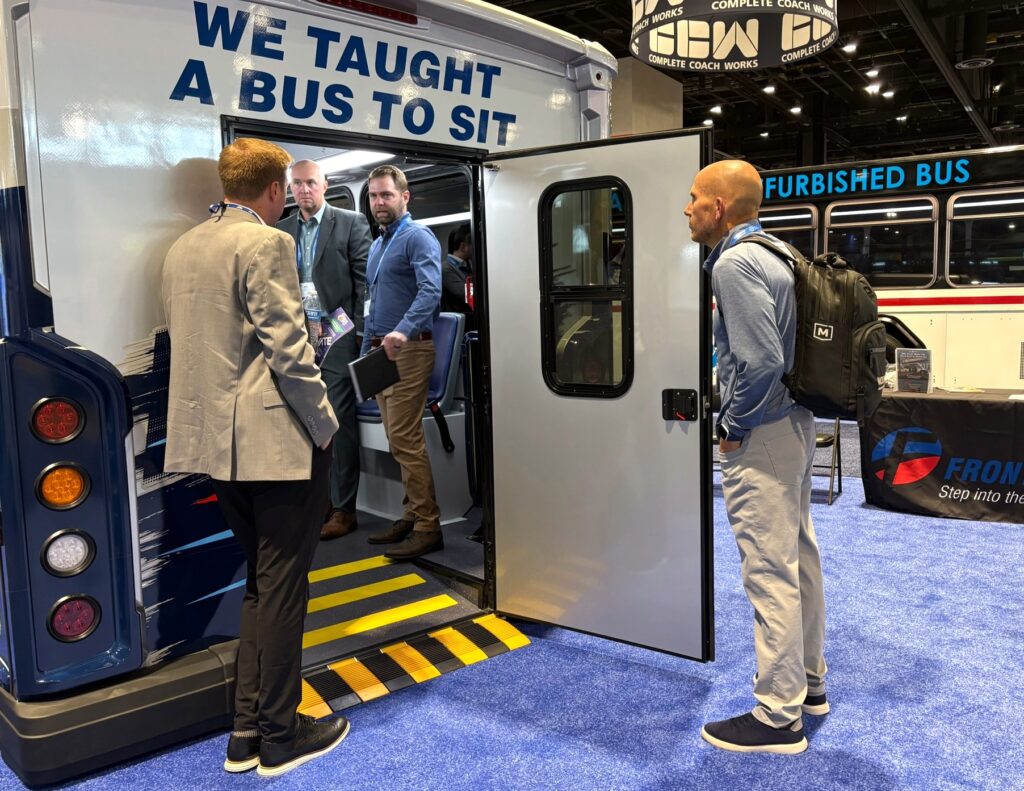
Spotlight: The Frontrunner XF
One low-floor model that drew steady attention all week was the Frontrunner XF. There were some highlights that resonated with attendees:
Rear egress exit
Only 2 feet longer than the current Frontrunner
Fully flat floor from front to back
8-inch step height when kneeling (or as the Frontrunner team say – “sits”)
Production and Altoona bus testing — required for vehicles purchased with federal funds — timelines are still unknown, so keep an eye on the Frontrunner LinkedIn for updates.
Want to see it up close? Factory tours have been a hit with agencies, and our team can help you schedule one. Reach out to your Model 1 representative to get started.
Some of the smartest ideas solved one specific problem
Not every standout came from a big name. A fair number of smaller manufacturers brought proprietary hardware, software or consultative services aimed squarely at everyday transit pain points.
One example: a universal A/V and PA system that works with either its own program or an agency’s existing software. It automatically adjusts the volume of announcements inside and outside the bus after a split-second read of the noise level in each space — so riders hear what they need to, whether the bus is packed or the street is loud.
International exhibitors also had a strong presence, showcasing advancements in light rail, electric bus lines and other technologies that have taken off overseas but are still seeing slower adoption in the U.S. It’s a useful preview of what could be coming next.
Many of the week’s most valuable meetings weren’t on anyone’s calendar. Customers and their sales reps often attended together — even when the rep wasn’t exhibiting — and walked the floor side by side.
For Joe Boyko, Model 1’s public sector sales lead for the Northeast, that was the highlight of his first flagship APTA EXPO. He spent time with a [New York agency’s] maintenance leadership and paratransit managers as they evaluated new vehicles and emerging technology, and reconnected with executive directors and transit leaders from across Pennsylvania.
“Seeing firsthand what OEMs, vehicle manufacturers, and technology providers are bringing to market helps us stay informed and better serve our customers.”
— Joe Boyko, Public Sector Sales, Northeast, Model 1
That’s exactly why we go. If you couldn’t make it to Chicago, your Model 1 rep can walk you through what they saw and how it applies to your fleet.
What this means for transit agencies
Those aisle conversations kept coming back to the same handful of questions. Whether you walked APTA EXPO 2026 or not, they’re worth asking as you plan:
Does that single-point solution actually integrate with the vehicles and systems you already run?
Which AI tools would reduce your team’s workload — and which would just add another screen?
Is low-floor the right wheelchair accessible bus for your routes, riders and service model?
Are you tracking Altoona bus testing status for vehicles in your federally funded pipeline? Our Grant Services team can help.
Do you have a partner who can bring the show to you, even when you can’t attend?
Final take: one partner, the whole picture
APTA EXPO 2026 made one thing clear: the industry is moving toward consolidation, accessibility and smarter technology — and vendors are racing to be the one-stop shop.
At Model 1, that’s not a new pitch. It’s how we’ve always tried to show up: helping you find the right vehicle, then supporting it with the parts, service and financing that keep it running. Making transit better for you — and the people who rely on you.
APTA EXPO is the American Public Transportation Association’s flagship trade show and the largest public transportation expo in North America. It takes place every three years; the 2026 show was held Oct. 4-7 at McCormick Place in Chicago.
What were the biggest trends at APTA EXPO 2026?
Single-point solutions that consolidate agency systems, a rise in AI and software products, and a wave of new low-floor vehicles led the conversation. International exhibitors also showcased light rail and electric bus technology that’s still gaining traction in the U.S.
Why are so many manufacturers offering low-floor vehicles?
Low-floor designs speed up boarding and make vehicles more accessible for riders using mobility devices. That flexibility makes them a strong fit across fixed-route, paratransit and microtransit service.
High floor vs low floor: Which bus is right for your agency?
Low-floor buses sit closer to the ground and typically use a ramp and kneeling feature, so riders board with few or no steps — including passengers using mobility devices.High-floor buses, often built on a cutaway chassis, require riders to climb steps and use a wheelchair lift for accessible boarding. The right fit depends on your routes, riders and service model.
What is Altoona bus testing, and why does it matterfor transit agencies?
Altoona testing is the Federal Transit Administration’s bus testing program. New bus models generally must complete it before agencies can purchase them with federal funds, so testing status directly affects federally funded bids and procurement timelines.
I couldn’t attend APTA EXPO. How can I catch up on what’s new?
Your Model 1 representative can walk you through the vehicles and technology our team saw on the floor and how they apply to your fleet. Contact us to connect with your local team.